
RESEARCH & ANALYSIS
g-CNT for Battery and Supercapacitor Electrode


Electrode performance depends on two things carbon does well: moving electrons and offering surface for ions. Graphenated carbon nanotubes (g-CNTs) are designed to do both in one particle. This article explains what g-CNT can add to supercapacitor and lithium-ion battery electrodes, and how to evaluate it.
Why carbon matters in electrodes
Carbon has been at the heart of lithium-ion batteries since they were first commercialised. Graphite anodes store lithium between their layers, with a theoretical capacity of 372 mAh/g. Carbon is also added to almost every cathode and anode as a conductive additive, because most active materials conduct electrons poorly.
Graphene and carbon nanotubes have pushed this further. Each brings a clear strength and a clear limitation.
Graphene offers a large surface and many edge sites. In an electrode, however, its sheets tend to restack, and the surface between them becomes hard for ions to reach.
Carbon nanotubes form long conductive networks at low loading. Their smooth walls offer few edges, and the tubes tend to bundle, which reduces the surface in contact with the electrolyte.
Many formulators now blend graphene with CNTs to get both. The result then depends on how well the two are mixed.
What g-CNT brings to electrodes
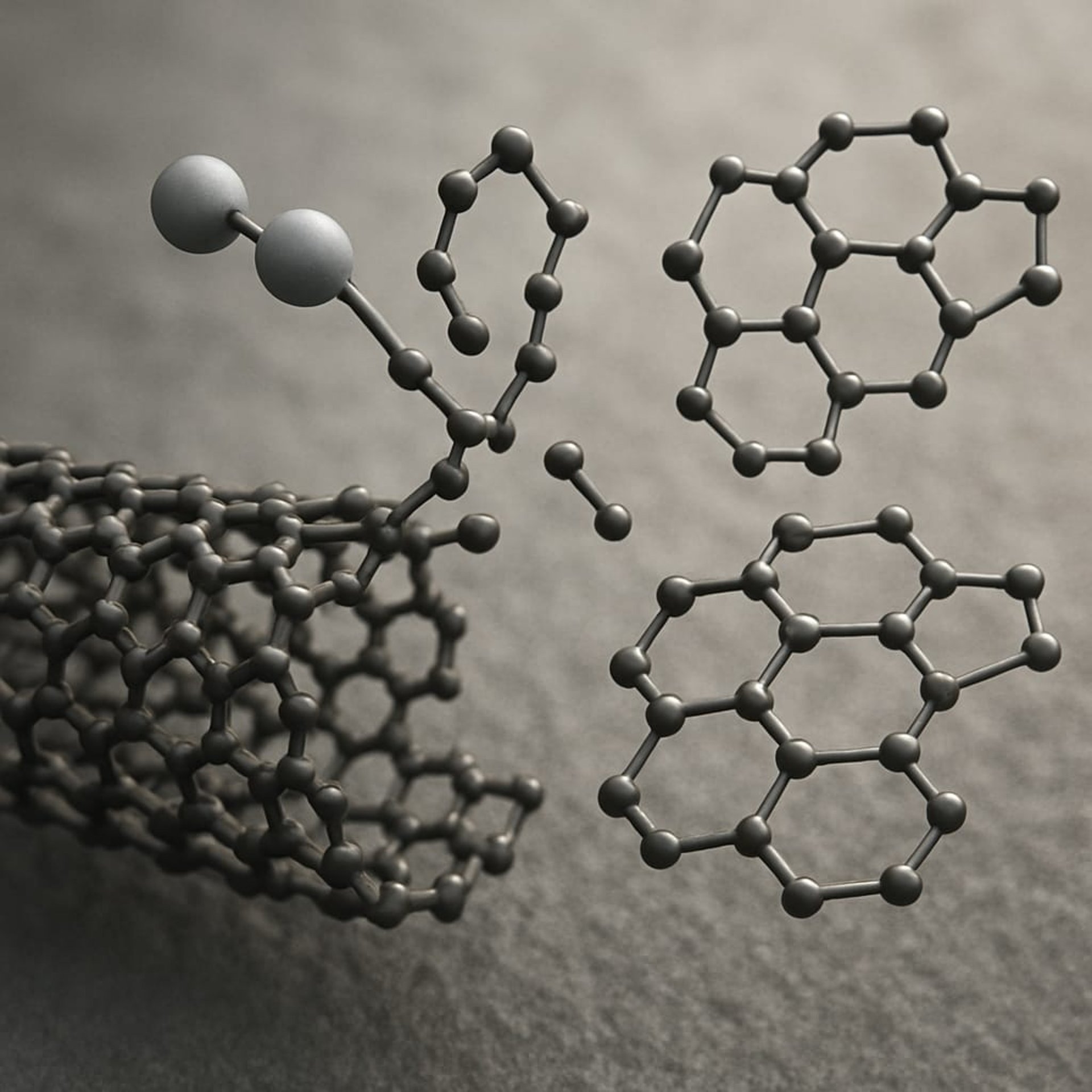
A g-CNT is a multi-walled carbon nanotube with few-layer graphene petals grown along its outer wall during synthesis. For electrode designers, this structure offers four features in one material.


Because graphene and nanotube come in one particle, formulators do not need to balance two separate carbon powders to get both functions.
Our own g-CNT shows this structure from the network scale down to single tubes.


Supercapacitors
Electrochemical double-layer capacitors store charge at the interface between carbon and electrolyte. Their capacitance depends on how much carbon surface the electrolyte can reach, and on what kind of surface it is. Graphite edge planes store far more charge than basal planes: about 50 to 70 µF/cm² against about 3 µF/cm². This is why the graphene edges on a g-CNT matter.
Published work on g-CNT electrodes shows a consistent pattern.


Two points stand out for developers. First, graphene foliates help pseudocapacitive oxides such as MnO₂ deposit more evenly, so more of the oxide is active even at commercially relevant loadings. Second, g-CNT can be made as a flexible, cotton-like network that serves as a binder-free electrode support.
For supercapacitor developers, g-CNT is worth testing as:
the main electrode carbon in double-layer capacitors;
a conductive, high-surface support for pseudocapacitive materials such as MnO₂, MoS₂ and WS₂;
a flexible, binder-free current collector and support for wearable devices.
Lithium-ion batteries
As a conductive additive
Most cathode materials and many anode materials need a conductive carbon to carry electrons to every particle. Carbon black works through point contacts. Carbon nanotubes reach further, because each tube can bridge many particles. A g-CNT keeps that long-range bridging and adds petals that can touch more particle surfaces along the way. Formulators who already use CNT additives can test g-CNT at the same or lower loading and compare electrode resistance and rate performance.
For silicon anodes
Silicon is the most studied next-generation anode, with a theoretical capacity of about 4200 mAh/g. Its weakness is a volume change of roughly 300 to 400% during charging and discharging. This cracks particles, breaks electrical contact and shortens cycle life.
A recent review of carbon nanohybrids for silicon anodes highlights two roles for nanocarbon (Lee et al., 2025):
carbon nanotubes form three-dimensional conductive networks that keep silicon particles connected as they expand and shrink;
graphene layers act as flexible, conductive coatings that accommodate the volume change.
The same review reports that a hybrid of reduced graphene oxide and multi-walled CNTs outperformed either additive alone. A g-CNT offers that combination in a single grown structure. This makes it a strong candidate for silicon–carbon anode development, and we welcome partners who want to test it.
Why GCNT
GCNT Sdn Bhd is a spin-off from Universiti Putra Malaysia. We produce graphenated carbon nanotubes.
Our g-CNT technology is protected.
Our research on g-CNT is peer reviewed, including work published in Journal of Physics D: Applied Physics (2026).
We supply g-CNT as dry powder for dry mixing and slurry preparation, and as Grafonex dispersions in water, ethanol or NMP at 0.5, 1.0 or 2.0 wt%. NMP dispersions suit cathode slurries. Water-based dispersions suit anode slurries and aqueous binders.
We work with battery and supercapacitor developers, research groups and cell manufacturers who want to test g-CNT in their own electrodes. Tell us your active material, binder and solvent system, and we will recommend a starting form and loading.
Contact us at info@mygcnt.com
References
Perişanoğlu, U., Kavaz Perişanoğlu, E., Kudaş, Z., Ekinci, D., Ismail, I., & Gür, E. (2025). Advanced flexible supercapacitors: Vertical 2D MoS₂ and WS₂ nanowalls on graphenated carbon nanotube cotton. Nanoscale, 17(11), 6704–6717. DOI 10.1039/d5nr00329f
Brown, B., Cordova, I. A., Parker, C. B., Stoner, B. R., & Glass, J. T. (2015). Optimization of active manganese oxide electrodeposits using graphenated carbon nanotube electrodes for supercapacitors. Chemistry of Materials, 27(7), 2430–2438. DOI 10.1021/cm504519m
Brown, B., Cordova, I. A., Ubnoske, S., Parker, C., Stoner, B. R., & Glass, J. T. (2014). Graphenated carbon nanotubes for enhanced nucleation of manganese oxide electrodeposits in high performance composite electrodes. 225th ECS Meeting, Orlando. Link
Stoner, B. R., Raut, A. S., Brown, B., Parker, C. B., & Glass, J. T. (2011). Graphenated carbon nanotubes for enhanced electrochemical double layer capacitor performance. Applied Physics Letters, 99, 183104. DOI 10.1063/1.3657514
Parker, C. B., Raut, A. S., Brown, B., Stoner, B. R., & Glass, J. T. (2012). Three-dimensional arrays of graphenated carbon nanotubes. Journal of Materials Research, 27(7). Link
Lee, W., Jung, Y., Hong, J. Y., Jeon, Y. P., & Lee, J. U. (2025). Nano carbon-based hybrid strategies for mitigating silicon anode expansion in lithium-ion batteries: A comprehensive review. Materials, 18(24), 5532. DOI 10.3390/ma18245532
g-CNT
High-purity graphenated carbon nanotube (g-CNT) technologies optimized for commercial EMI shielding and advanced industrial applications.
Sitemap
Inquiries
GCNT SDN. BHD.
Institute of Nanoscience and Nanotechnology (ION2) Universiti Putra Malaysia Persiaran Universiti 2 43400 Serdang Selangor Darul Ehsan Malaysia
email:
Phone contact: +60 17324 3063/ +60123510091 / +601133422645
Commercial orders & product integration support
© 2024 GCNT - GCNT Sdn Bhd. All rights reserved. Advanced Carbon Nanotechnology


APPLICATIONS
Energy Storage
Semiconductor & AI Hardware
EMI Shielding & Electronics
Aerospace & Defense
Polymer & Structural Composites
Thermal Management
Electrocatalysis & Energy Conversion
Sensors
About Us