As power densities increase in AI hardware, power electronics, EV batteries, and advanced semiconductor packaging, efficient thermal management has become a critical challenge.
The TIM Challenge
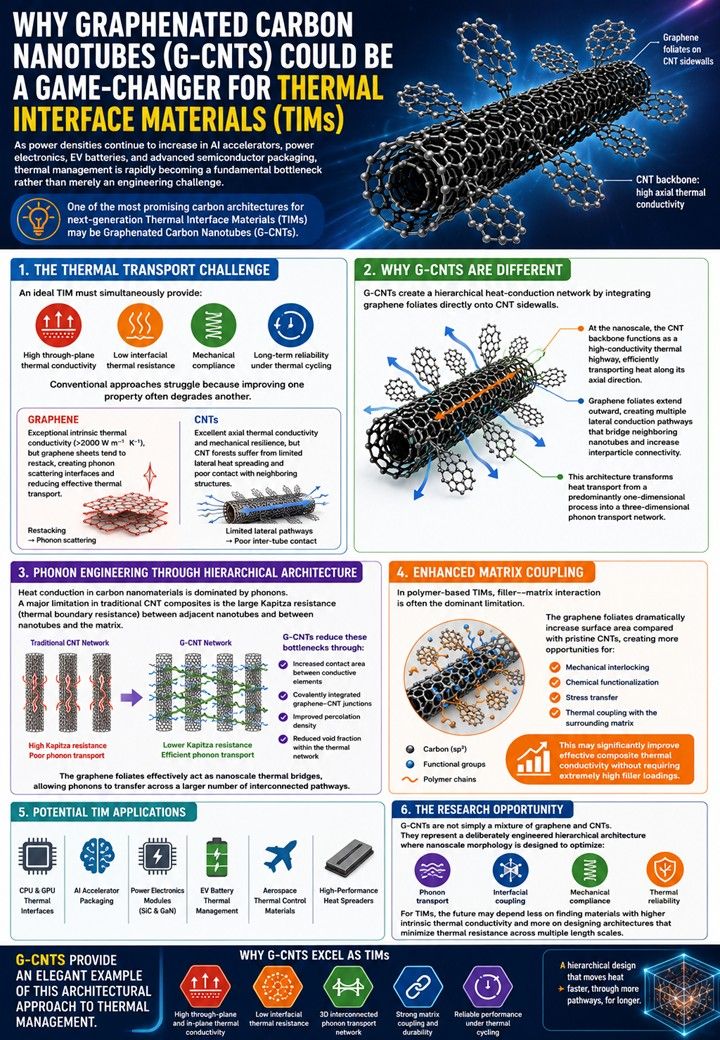
An ideal TIM requires:
✅ High thermal conductivity
✅ Low interfacial thermal resistance
✅ Mechanical compliance
✅ Long-term thermal reliability
Graphene offers exceptional thermal conductivity but suffers from restacking. CNTs provide efficient axial heat transport but have limited lateral heat spreading and poor inter-tube contact.
Why g-CNTs Are Different
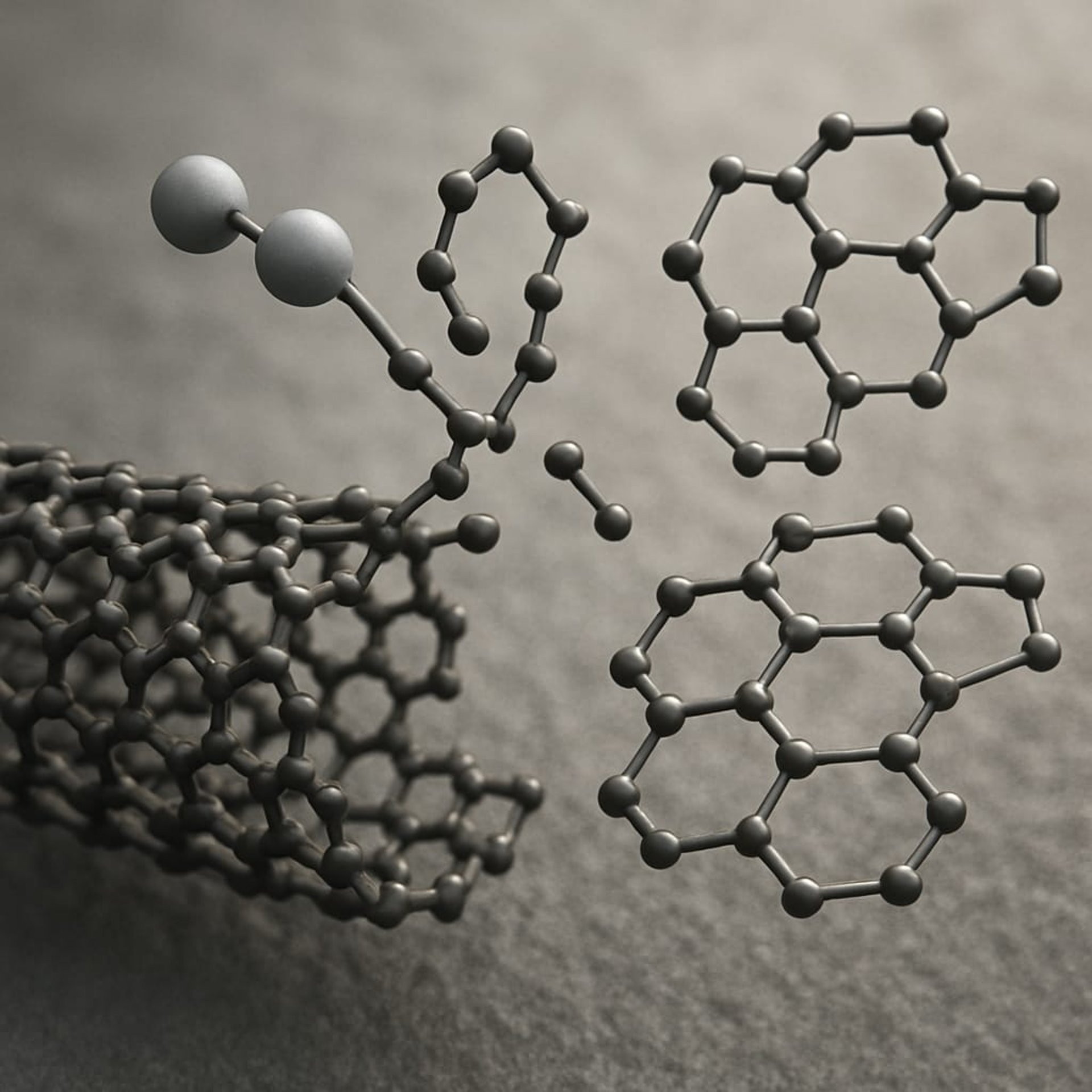
Graphenated Carbon Nanotubes (g-CNTs) combine a conductive CNT backbone with graphene foliates grown directly on the CNT sidewalls.
This hierarchical architecture creates:
• Fast axial heat transport through CNTs
• Lateral heat-spreading pathways through graphene foliates
• A 3D interconnected phonon transport network
Reducing Thermal Resistance
g-CNTs can improve thermal transport by:
• Increasing conductive contact area
• Creating covalently integrated graphene-CNT junctions
• Enhancing percolation pathways
• Reducing voids within the thermal network
Graphene foliates act as nanoscale thermal bridges, facilitating phonon transport across interconnected structures.
Improved Polymer Matrix Coupling
The high-surface-area graphene foliates promote:
• Better filler-matrix interaction
• Mechanical interlocking
• Chemical functionalization
• Enhanced thermal coupling
This can improve composite thermal conductivity without requiring excessive filler loading.
Potential Applications
🔹 CPU & GPU thermal interfaces
🔹 AI accelerator packaging
🔹 Power electronics (SiC & GaN)
🔹 EV battery thermal management
🔹 Aerospace thermal systems
🔹 High-performance heat spreaders
Key Takeaway
g-CNTs are not simply a mixture of graphene and CNTs—they are an engineered hierarchical architecture designed to optimize phonon transport, interfacial coupling, and thermal reliability. Their greatest advantage lies in minimizing thermal resistance across multiple length scales, making them highly promising for next-generation TIMs.