
RESEARCH & ANALYSIS
Supercapacitors: Moving Beyond Limited & Inefficient Energy Storage
Energy storage technology is at a critical juncture. While advanced materials like graphene and carbon nanotubes (CNTs) have long been heralded as the future, they often fall short of their theoretical potential in practical, bulk applications. But what happens when you combine the best traits of both?
The result is a three-dimensional structural breakthrough that is fundamentally reshaping the capabilities of supercapacitors.
The Bottleneck: Why Traditional Materials Fall Short
Historically, most carbon-based energy storage materials face two persistent structural problems that severely limit their efficiency:
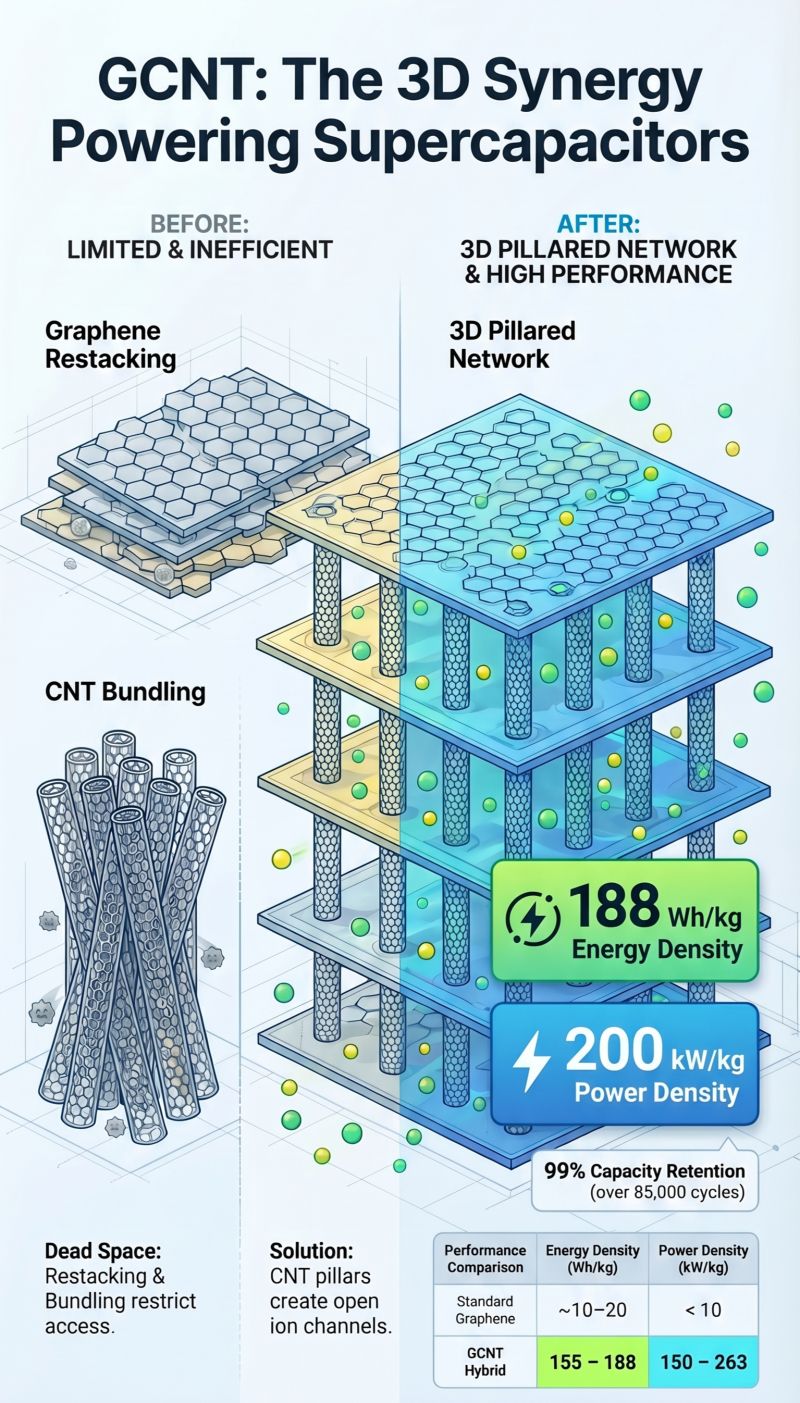
Graphene Restacking: 2D graphene sheets naturally tend to restack upon one another due to strong van der Waals forces. This phenomenon drastically reduces the electrochemically active surface area.
CNT Bundling: 1D carbon nanotubes are notorious for clumping and bundling together, which restricts ion flow and creates inactive "dead spaces" within the electrode matrix.
The consequence of these structural flaws is a frustrating plateau in development: limited overall performance, high material waste, and low efficiency.
The Structural Solution: Enter 3D g-CNTs
The solution to these bottlenecks isn't just about changing the chemistry; it requires a structural evolution. Graphenated Carbon Nanotubes (g-CNTs) introduce a true 3D pillared network designed to overcome the limitations of standard nanomaterials.
By seamlessly growing 2D graphene foliates directly onto robust 1D CNT pillars, g-CNTs create an open, highly porous matrix. The rigid CNT stems actively prevent the graphene sheets from restacking, while the protruding graphene foliage stops the nanotubes from clumping together. This unique structural synergy ensures continuous, clear ion channels and a massive, accessible surface area. We are moving from a "limited and inefficient" structure to a fully optimized, 3D pillared network.
The Numbers Speak for Themselves
When you eliminate structural dead space and optimize ion transport, the performance leaps are staggering. For supercapacitor applications, g-CNTs deliver unprecedented metrics:
Energy Density: 188 Wh/kg
Power Density: 200 kW/kg
Cycle Life: 99% capacity retention after 85,000 cycles
To put this into perspective, standard commercial graphene typically yields an energy density of only ~10–20 Wh/kg and a power density of <10 kW/kg. The transition to g-CNTs is not a small step—it is a monumental leap in materials science.
Redefining Supercapacitors for the Real World
For the energy storage industry, this architecture unlocks the true potential of supercapacitors. It means achieving ultra-fast charge and discharge rates and incredible operational lifespans, alongside an energy density that is finally starting to rival traditional batteries—all without the rapid chemical degradation.
It is an exciting era for materials science, as engineered structural connectivity transforms theoretical promise into real-world performance.
g-CNT
High-purity graphenated carbon nanotube (g-CNT) technologies optimized for commercial EMI shielding and advanced industrial applications.
Sitemap
Inquiries
GCNT SDN. BHD.
Institute of Nanoscience and Nanotechnology (ION2) Universiti Putra Malaysia Persiaran Universiti 2 43400 Serdang Selangor Darul Ehsan Malaysia
email:
Phone contact: +60 17324 3063/ +60123510091 / +601133422645
Commercial orders & product integration support
© 2024 GCNT - GCNT Sdn Bhd. All rights reserved. Advanced Carbon Nanotechnology


APPLICATIONS
Energy Storage
Semiconductor & AI Hardware
EMI Shielding & Electronics
Aerospace & Defense
Polymer & Structural Composites
Thermal Management
Electrocatalysis & Energy Conversion
Sensors
About Us