What happens when you combine the ballistic axial transport of 1D carbon nanotubes with the high specific surface area of 2D graphene?
You break the fundamental macroscale performance bottlenecks that have limited carbon nanotechnology for decades.
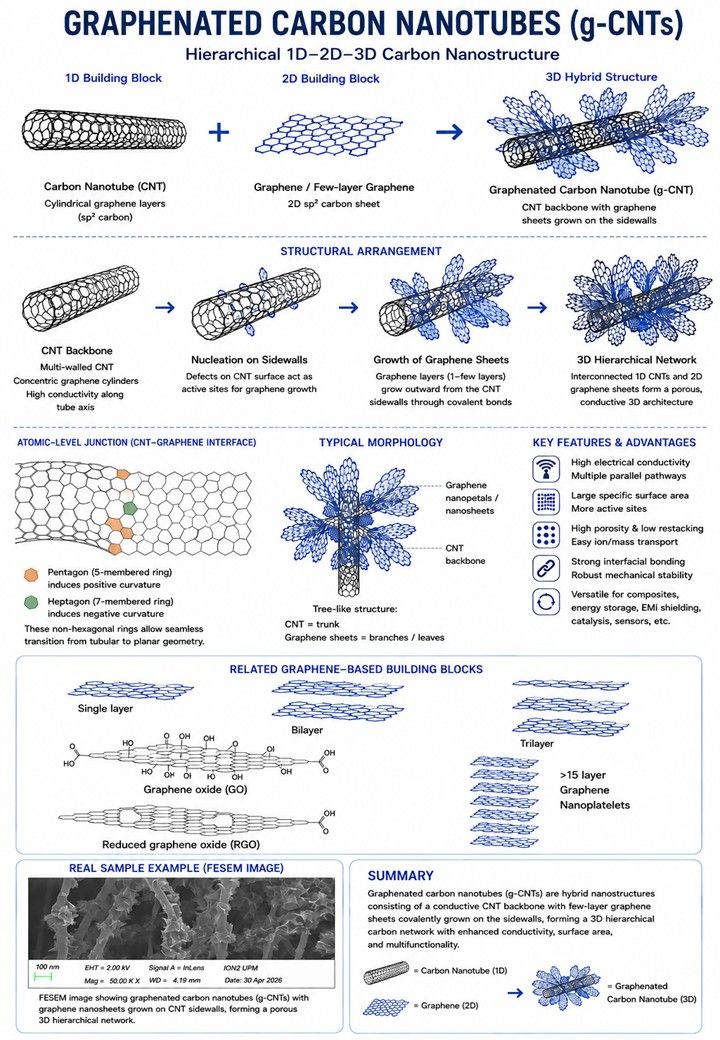
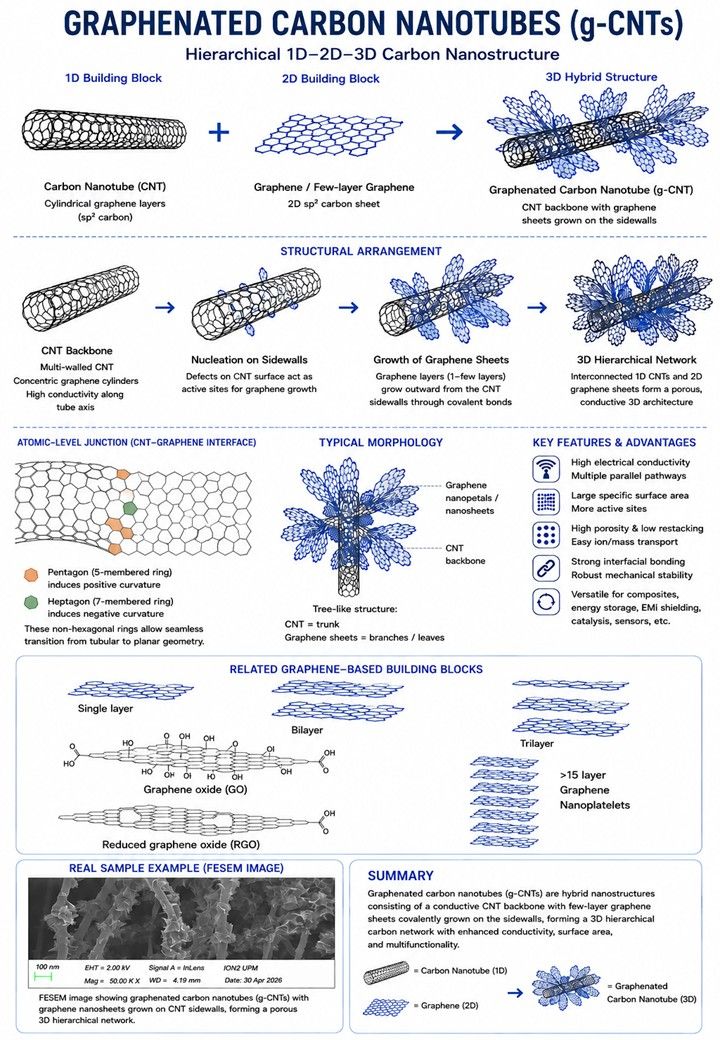
We are excited to share a comprehensive architectural breakdown of Graphenated Carbon Nanotubes (g-CNTs), a true hierarchical 3D hybrid nanostructure often described as the "tree-like" paradigm of the nano-world.
While standalone 1D nanotubes naturally bundle and 2D graphene sheets suffer from performance-limiting π- π restacking, g-CNTs solve these challenges through absolute geometric and atomic symbiosis:
The Growth Process: Using a multi-walled carbon nanotube backbone as a conductive trunk, localized surface defects act as active nucleation sites. From these sites, few-layer graphene sheets grow outward as orthogonal "leaves" via seamless covalent bonds.
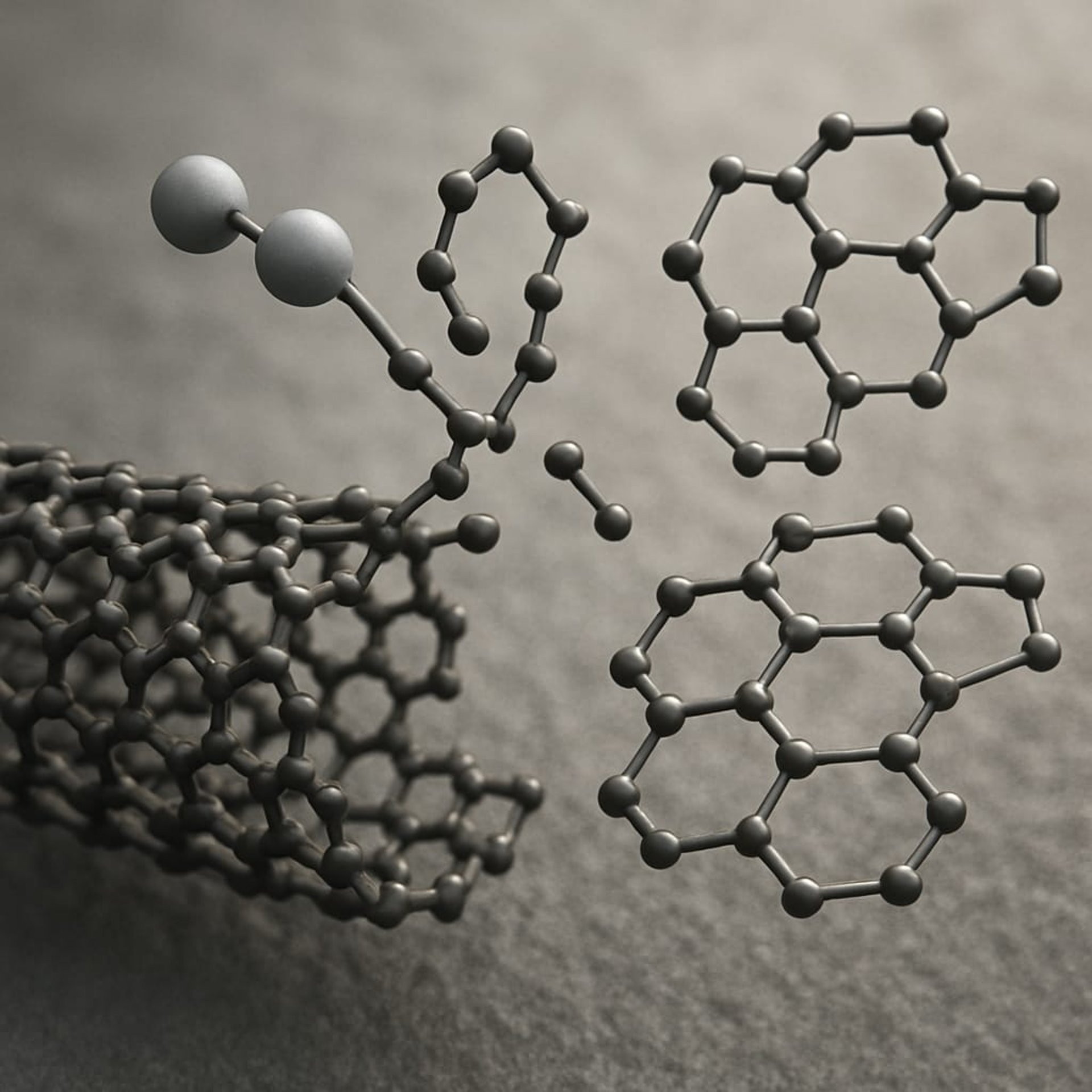
The Atomic Transition: This topological transformation from cylindrical to planar geometry is made possible by the unique inclusion of non-hexagonal rings. Pentagons (5-membered rings) induce positive curvature, while heptagons (7-membered rings) induce negative curvature, preserving continuous sp2 electronic pathways throughout the entire 3D framework.
Engineering Advantages: By introducing permanent steric hindrance against bundling and aggregation, g-CNTs unlock immense porosity for seamless ion/mass transport, offer multiple parallel conduction pathways, and deliver superior interfacial mechanical anchoring.
This multi-dimensional synergy makes g-CNTs the next-generation candidate to redefine performance thresholds in silicon anodes, ultra-fast energy storage, advanced catalyst supports, and omnidirectional electromagnetic interference (EMI) shielding.
Check out the full infographic below for an in-depth look into the morphology, structural arrangements, and real-world field emission scanning electron microscopy (FESEM) tracking of this remarkable material.
How could a 3D hierarchical carbon architecture resolve the processing or transport bottlenecks in your current research or engineering pipelines? Let us know in the comments below, and follow our page for more deep dives into advanced materials science.