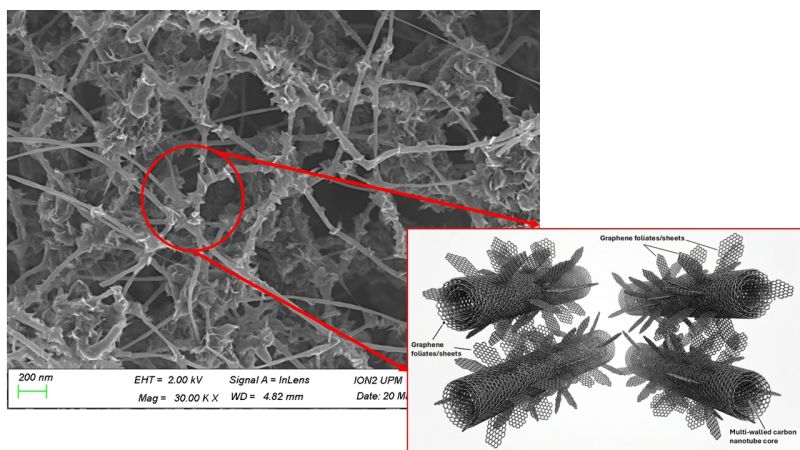
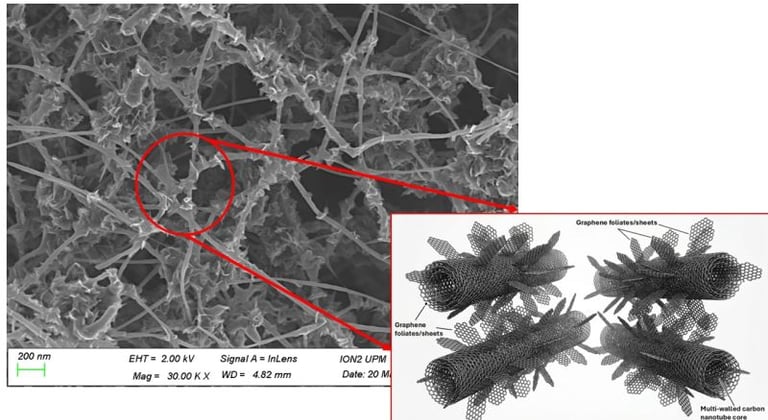
Let’s take a look at the FESEM micrograph. While it might look like a highly complex microscopic web, it is actually a meticulously engineered by our company, dual-dimensional architecture designed to solve some of the most persistent bottlenecks in material science.
What Exactly Are gCNTs?
Think of g-CNTs as a powerful hybrid structure. The schematic inset perfectly breaks down the two main components driving this unique morphology:
1) The Conductive Superhighway (1D Backbone): At the center lies a multi-walled carbon nanotube. This acts as an incredibly strong structural pillar and a high-speed highway for long-range electron transport.
2) The Functional Branches (2D Foliates): Unlike traditional nanotubes that have smooth, flat surfaces, g-CNTs feature distinct graphene sheets protruding outward, much like leaves on a branch.
Is it related to your next project?
From a manufacturing and performance standpoint, this "branch-and-core" geometry naturally resolves common industry headaches associated with traditional carbon additives:
1) Unlocking Massive Surface Area: Those protruding graphene leaves dramatically increase the available active surface area. They provide a high density of reactive "edge" sites, making the material exceptionally efficient for catalytic anchoring and electrochemical interactions.
2) Solving the "Clumping" Problem: Standard carbon nanotubes are notorious for bundling and clumping together, which severely restricts their performance and makes them difficult to mix. In g-CNTs, the graphene branches physically act as built-in spacers. This prevents dense packing, keeps the network open and porous, and allows for rapid ion diffusion and superior integration into polymer matrices or electrolytes.
By elegantly combining the high electrical conductivity of a core tube with the massive reactive surface area of 3D edges, g-CNTs effectively eliminate the traditional trade-offs between conductivity and accessible surface area. Whether your team is developing next-generation energy storage systems, advanced electrocatalysis, or high-performance composites, this structural synergy can significantly elevate your product's capabilities.
I'd love to connect and hear what you're currently building. Feel free to reach out if you would like to explore how integrating g-CNTs could specifically benefit your R&D pipeline!