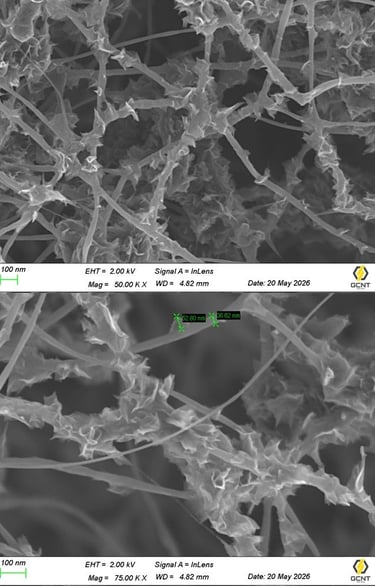
A few people recently asked if we could share higher magnification images of our g-CNTs. These FESEM micrographs provide a closer view of the unique hybrid architecture that distinguishes this material from conventional carbon nanotubes.
Unlike pristine CNTs with relatively smooth sidewalls, our g-CNTs consist of graphene nanosheets grown directly from the basal plane of carbon nanotubes. This creates a 3-dimensional hierarchical carbon network with abundant exposed graphene edges while preserving the one-dimensional conductive backbone of the nanotube. The morphology observed here reflects a significant increase in accessible edge sites, defect-engineered interfaces, and surface roughness, all of which are critical for interfacial charge transfer, mechanical interlocking, and active surface interactions.
From a materials science perspective, this architecture addresses several long-standing limitations of conventional CNTs. The graphene protrusions reduce nanotube restacking, enhance load transfer within composites, and create additional electron transport pathways across neighboring nanostructures. The result is a hybrid nanomaterial that can simultaneously improve electrical conductivity, thermal transport, surface reactivity, and reinforcement efficiency without relying solely on higher filler loading.
The measured nanotube diameters shown in the high-magnification image remain within the expected nanoscale range, while the graphene growth substantially increases the effective surface area and electron edge density. These structural characteristics make g-CNTs particularly attractive for next-generation energy storage, EMI shielding, conductive composites, thermal interface materials, catalysis, and multifunctional structural materials.
We are excited to move beyond laboratory-scale research. Our Graphenated Carbon Nanotubes are now being commercialized, enabling researchers and industrial partners to evaluate this unique carbon architecture for real-world applications.