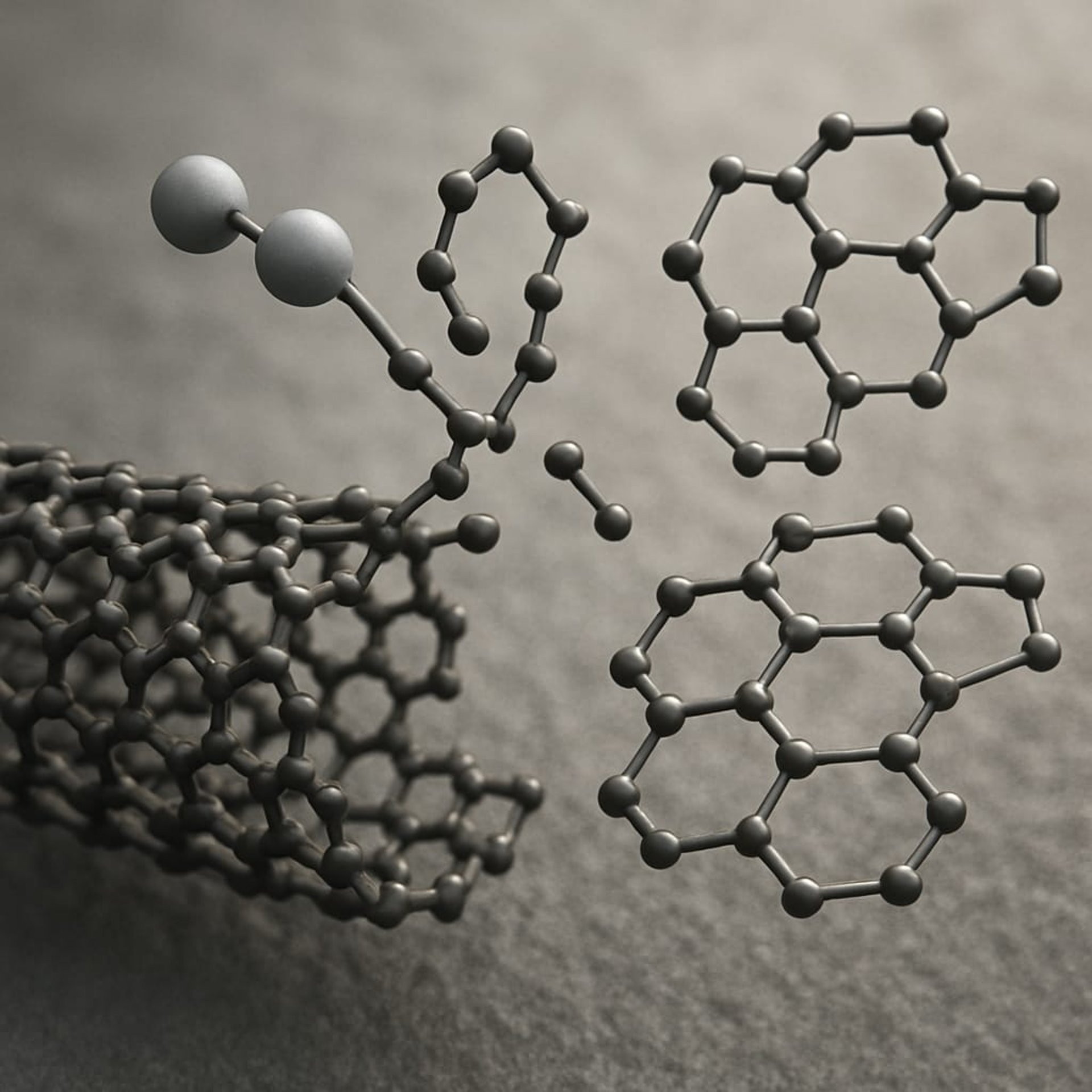
For more than three decades, carbon nanomaterials have advanced through successive breakthroughs, each overcoming limitations of the previous generation rather than replacing it.
The first revolution belonged to carbon nanotubes (CNTs). Their exceptional electrical conductivity, mechanical strength, and thermal transport transformed composites, electronics, sensors, and energy storage. Yet strong van der Waals interactions cause CNTs to agglomerate, limiting accessible surface area for electrochemical reactions and catalyst utilization.
The second revolution came with graphene. Its atomically thin two-dimensional structure offers extraordinary carrier mobility and immense theoretical surface area. However, graphene sheets naturally restack during processing, reducing accessible interfaces and limiting practical performance.
This highlights an important principle in materials science. Outstanding intrinsic properties alone do not guarantee superior functional performance. Electrode architecture and nanoscale organization are equally important.
This is where graphenated carbon nanotubes (g-CNTs) represent a significant advance.
Unlike simple CNT/graphene mixtures, graphene nanosheets are directly grown from carbon nanotube sidewalls, creating a covalently integrated three-dimensional hierarchical carbon framework. The graphene branches suppress CNT bundling, prevent graphene restacking, and create a conductive network that combines the advantages of one-dimensional and two-dimensional carbon.
This architecture provides:
-Greater electrochemically accessible surface area.
-More graphene edge-active sites for catalytic and electrochemical reactions.
-Continuous electron transport through the CNT backbone.
-Improved catalyst dispersion and anchoring.
-Hierarchical porosity that promotes rapid ion diffusion.
Rather than asking whether CNTs or graphene are superior, a better question is:
1) Can we engineer carbon architectures that overcome the limitations of both?
Graphenated carbon nanotubes represent one answer.
As advanced technologies demand faster electrochemical kinetics, higher energy density, improved thermal management, and multifunctional materials, the focus is shifting from individual nanomaterials toward hierarchically engineered carbon architectures.
The future of carbon nanotechnology may not lie in discovering another carbon allotrope, but in intelligently engineering existing ones into integrated functional systems.
Graphene changed how we think about carbon. Graphenated carbon nanotubes are changing how we engineer it.