For years, carbon nanotubes (CNTs) have been regarded as one of the most promising nanomaterials due to their exceptional electrical, mechanical, and thermal properties. Yet despite decades of research, large-scale industrial adoption has remained slower than many expected.
Why?
The answer lies not in the intrinsic properties of CNTs, but in the way they behave as bulk materials.
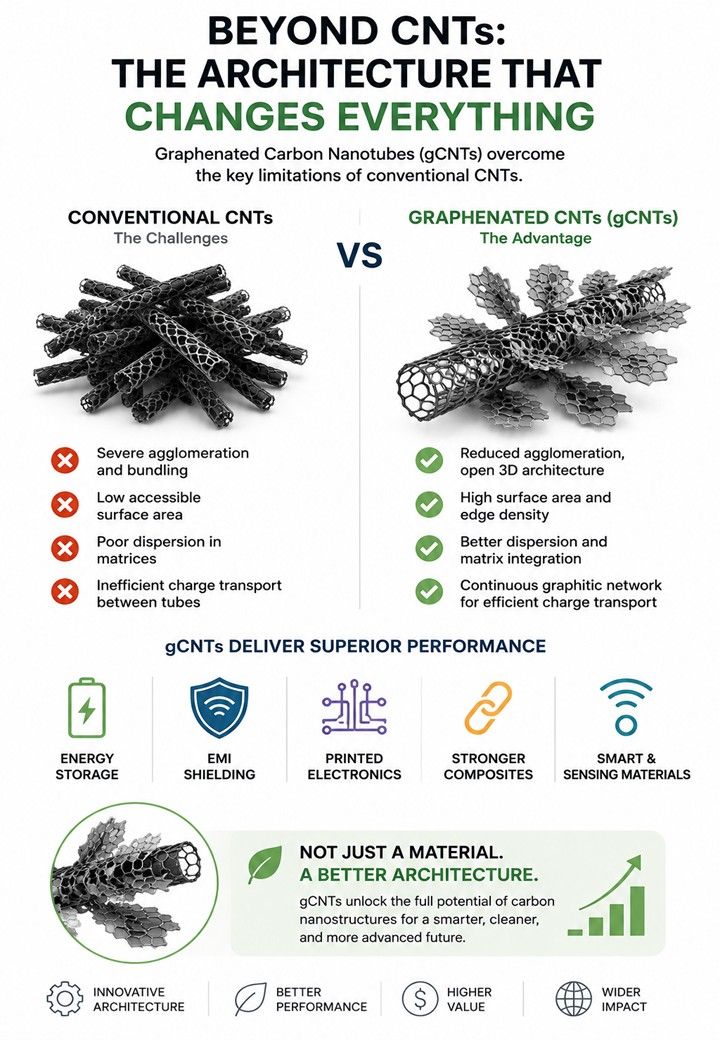
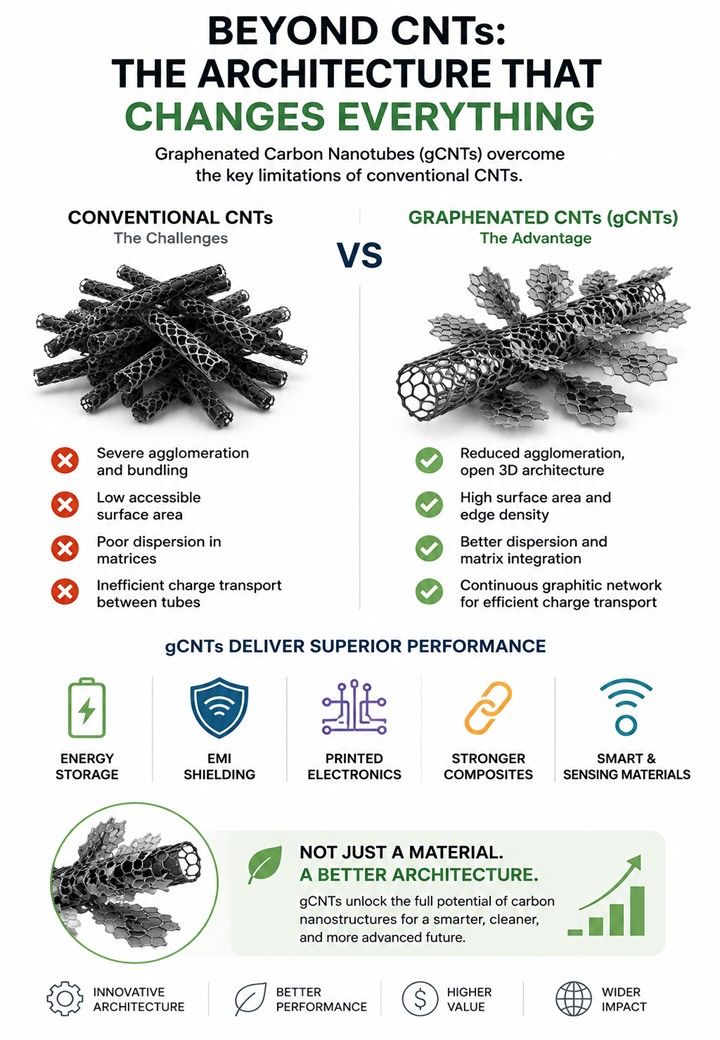
Conventional CNTs tend to form dense bundles because of strong van der Waals interactions. This agglomeration makes uniform dispersion difficult, limiting performance in composites, coatings, batteries, and many other applications. Manufacturers also face challenges related to purification, catalyst residues, batch-to-batch consistency, and processing.
This raises an important question:
What if the material architecture itself could overcome these limitations?
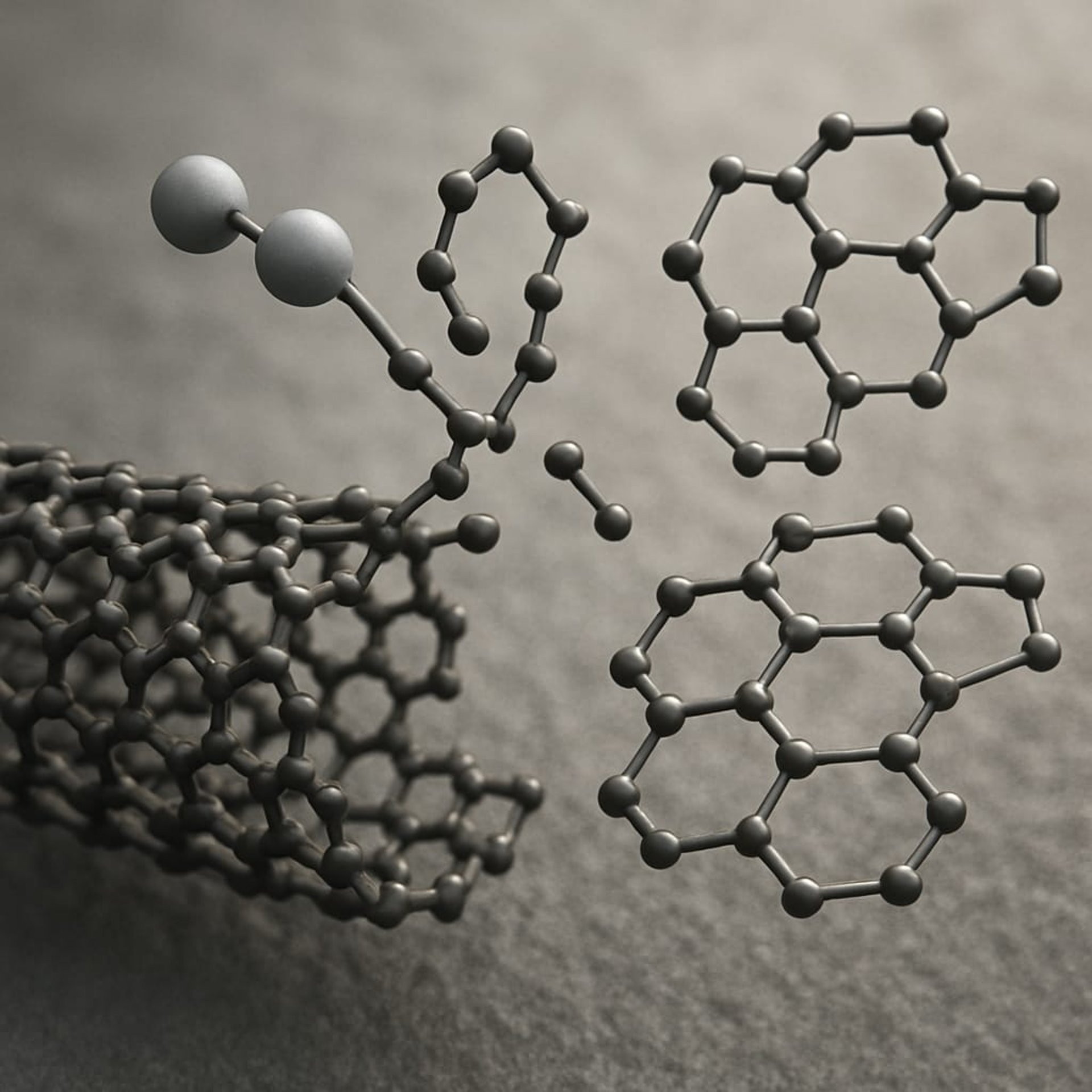
Graphenated carbon nanotubes (g-CNTs) offer a different approach. Instead of smooth nanotubes, graphene nanosheets are grown directly on CNT sidewalls, creating a hierarchical three-dimensional conductive architecture.
This architecture can:
• Reduce dense CNT agglomeration by preventing tight bundling.
• Increase accessible surface area and exposed graphitic edge density.
• Form continuous graphitic pathways with low junction resistance for efficient charge transport.
• Improve interactions with surrounding matrices through a more open and interconnected network.
While g-CNTs do not eliminate every challenge such as manufacturing consistency, purification, or occupational safety, they directly address several of the structural bottlenecks that have limited conventional bulk CNTs.
Sometimes, the next breakthrough is not about discovering a new material. It is about redesigning the architecture of an existing one.
We believe hierarchical carbon nanostructures like graphenated carbon nanotubes could play an important role in advancing next-generation energy storage, conductive composites, printed electronics, EMI shielding, and smart sensing materials.
What applications do you think stand to benefit most from this architectural evolution?