

RESEARCH & ANALYSIS
Graphene, Nanotubes, and the Hybrid Nobody Told You About: Meet Graphenated Carbon Nanotubes
Graphene and carbon nanotubes get the spotlight, but a hybrid of the two, grown, not just blended, is quietly outperforming both in capacitor electrodes.
Two Materials, One Lattice
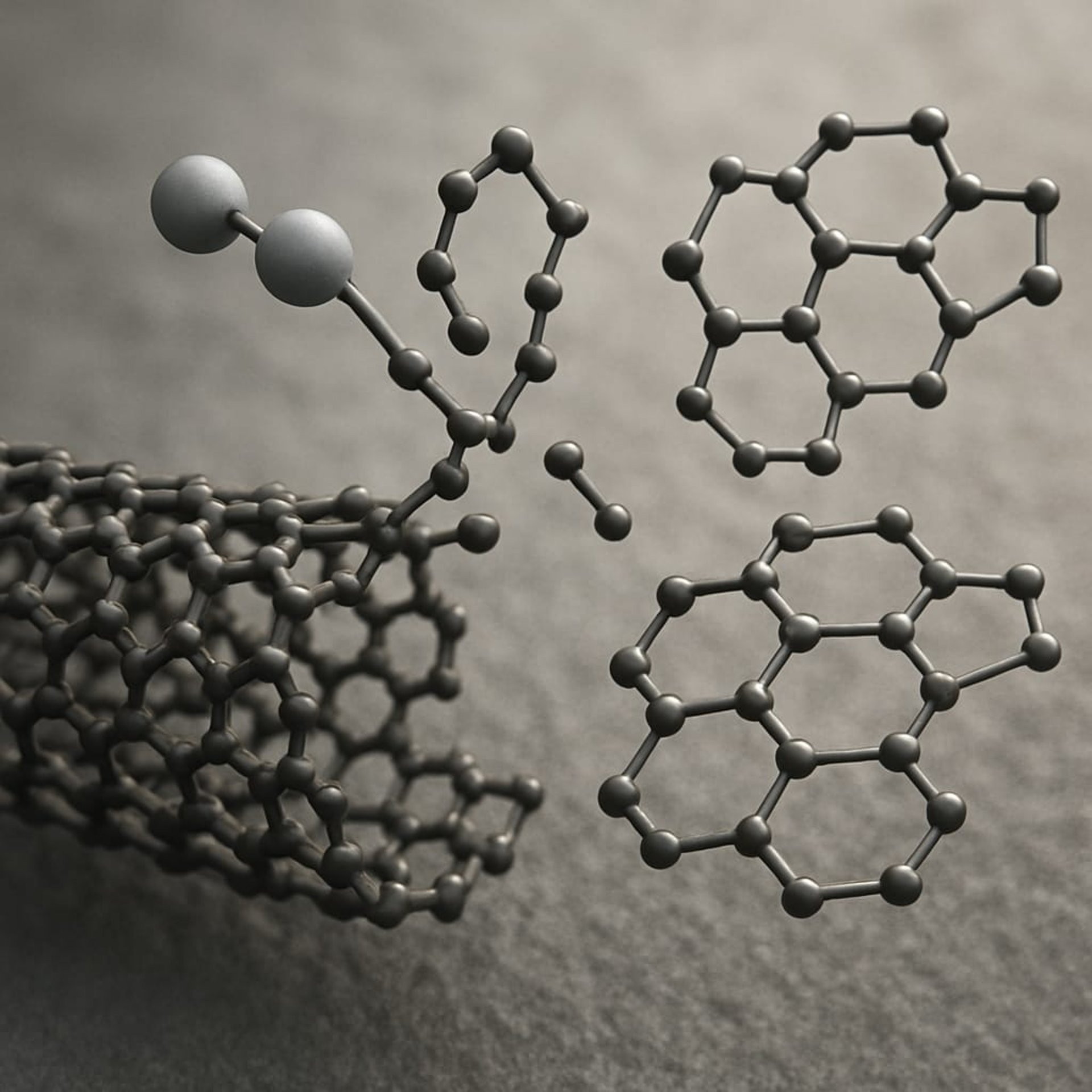
Graphene and carbon nanotubes get most of the attention in carbon nanotechnology, and for good reason. Both are built from the same sp2-hybridized hexagonal carbon lattice. A CNT is, structurally, a graphene sheet rolled into a cylinder, so the two share a common ancestor. What changes is dimensionality, and that one change reshapes almost everything about how each material behaves.
Graphene stays flat: a one-atom-thick sheet, and a zero-gap semimetal. It conducts well in every in-plane direction but has no natural band gap. Roll that same lattice into a tube and the electronic picture splits in two. Depending on chirality, meaning the angle and diameter at which the sheet is wound, a CNT comes out either metallic or semiconducting. Both forms are stiff, strong, and carry heat efficiently, which is why the field has treated them as complements rather than competitors for the better part of two decades: graphene for flexible, transparent films; CNTs for high-strength fibers and composite reinforcement.
There is a third structure that borrows from both, and it does not get nearly as much press: the graphenated carbon nanotube, or g-CNT.


What a Graphenated Carbon Nanotube Actually Is
The name says what it is. A g-CNT is a carbon nanotube that has been "graphenated," meaning decorated with graphene rather than left as a bare tube. Stoner and colleagues were among the first to report the structure, in 2011. They grew arrays of aligned CNTs and watched graphene "foliates" nucleate and sprout from the sidewalls as deposition continued, so instead of a smooth cylindrical wall, each tube ended up fringed with few-layer graphene.
A year later, Parker and coworkers mapped out how those foliates form across three-dimensional arrays of the hybrid tubes. They found foliate density and layer thickness track deposition conditions closely enough to be tuned on purpose, and that the exposed foliate edges approach true graphene dimensions, the exact feature a bare CNT wall does not offer.
The clearest picture of what this looks like came from a 2018 Nature Communications paper by Xiong and colleagues. They designed a bioinspired "leaves-on-branchlet" structure, with CNT arrays as the branchlets and graphene petals standing in for the leaves, modeled on how a tree maximizes exposed leaf surface to take in gas from its surroundings. Their argument was that the sharp edges of those graphene petals, more than the CNT backbone itself, do most of the work in governing charge transfer and storage.
Why Bother Growing Graphene on a Tube
It is not a cosmetic upgrade. A bare CNT has a smooth, low-defect wall that is efficient for conducting charge along its length, but it does not offer much exposed edge to an electrolyte, a gas molecule, or whatever analyte a sensor is meant to catch. Graphene has close to the opposite problem: enormous edge and basal-plane area, but no obvious way to move that charge over long distances. Put graphene foliates on a CNT and, in principle, the finished structure keeps the tube's long-range conduction while gaining the edges' surface charge density.
The numbers back this up. Stoner's group measured a 5.4-fold increase in weight-specific capacitance for graphenated CNTs over equivalent bare CNTs, and a 7.3-fold jump in capacitance per unit area under pulsed charge injection, and that was with foliates still fairly early-stage in terms of growth control. Xiong's leaves-on-branchlet electrodes did even better on an areal basis: 2.35 F/cm², with about 95% of that capacitance still there after 10,000 cycles. What ties both results together is that foliate density and thickness scale with growth time, so the ratio of "CNT-like" to "graphene-like" behavior in the finished material is something a grower can dial in, not something fixed by the chemistry.
That dial keeps getting finer. Rambo and colleagues published a 2025 study in which g-CNT forests, grown by plasma-enhanced chemical vapor deposition, were coated with TiO₂ using atomic layer deposition. The oxide added Faradaic pseudocapacitance on top of the g-CNT scaffold's own double-layer capacitance, and cyclic voltammetry showed the coating also improved cyclic stability. Push the TiO₂ layer too thick, though, and it starts to trade off against foliate density, so the two variables have to be balanced against each other rather than maximized independently.
Side by Side


Where Each One Actually Gets Used
None of the three makes the others obsolete. Graphene wins where a transparent, flexible, highly conductive film is the point: touchscreens, coatings, barrier layers. Conventional CNTs still dominate as high-strength fibers, composite reinforcement, and transistor channels, where axial conductivity and mechanical toughness matter more than surface area. Graphenated CNTs sit in the gap between the two: applications that need the CNT's structural and electrical backbone but also need the surface area and edge density that only a graphene-like layer can add. Supercapacitor and battery electrodes are the obvious fit so far, along with catalyst supports and sensing platforms, where more exposed surface generally means a stronger signal.
Where This Leaves the Field
Strip away the acronyms and it comes down to one lattice, expressed three ways: flat, rolled, or rolled-and-fringed. Graphenated CNTs are what you get when a grower stops picking one geometry and grows both into the same particle: a CNT trunk that keeps its axial conductivity, wearing graphene foliates that add the high-surface-charge edges the bare tube never had. As control over foliate density, layer thickness, and coating chemistry keeps improving, we expect g-CNTs to move past their current niche in capacitor electrodes and into a broader set of sensing and energy-storage applications, though how far that goes will depend on whether foliate growth can be scaled as reliably as CNT growth already has been.
References
ACS Material. (2025). Carbon nanotubes vs. graphene: Differences, properties & uses. https://www.acsmaterial.com/blog-detail/whats-the-difference-between-nanotubes-and-graphene.html
Parker, C. B., Raut, A. S., Brown, B., Stoner, B. R., & Glass, J. T. (2012). Three-dimensional arrays of graphenated carbon nanotubes. Journal of Materials Research, 27(7), 1046–1053. https://doi.org/10.1557/jmr.2012.43
Stoner, B. R., Raut, A. S., Brown, B., Parker, C. B., & Glass, J. T. (2011). Graphenated carbon nanotubes for enhanced electrochemical double layer capacitor performance. Applied Physics Letters, 99(18), 183104. https://doi.org/10.1063/1.3657514
Xiong, G., He, P., Lyu, Z., Chen, T., Huang, B., Chen, L., & Fisher, T. S. (2018). Bioinspired leaves-on-branchlet hybrid carbon nanostructure for supercapacitors. Nature Communications, 9, 790. https://doi.org/10.1038/s41467-018-03112-3
Rambo, C., et al. (2025/2026). Tuning electrochemical performance of graphenated carbon nanotubes through atomic layer deposition of TiO₂. Energy Technology, 14, e202501480. https://doi.org/10.1002/ente.202501480
Gupta, N., Gupta, S. M., & Sharma, S. K. (2019). Carbon nanotubes: synthesis, properties and engineering applications. Carbon Letters, 29(5), 419–447. https://doi.org/10.1007/s42823-019-00068-2
g-CNT
High-purity graphenated carbon nanotube (g-CNT) technologies optimized for commercial EMI shielding and advanced industrial applications.
Sitemap
Inquiries
GCNT SDN. BHD.
Institute of Nanoscience and Nanotechnology (ION2) Universiti Putra Malaysia Persiaran Universiti 2 43400 Serdang Selangor Darul Ehsan Malaysia
email:
Phone contact: +60 17324 3063/ +60123510091 / +601133422645
Commercial orders & product integration support
© 2024 GCNT - GCNT Sdn Bhd. All rights reserved. Advanced Carbon Nanotechnology


APPLICATIONS
Energy Storage
Semiconductor & AI Hardware
EMI Shielding & Electronics
Aerospace & Defense
Polymer & Structural Composites
Thermal Management
Electrocatalysis & Energy Conversion
Sensors
About Us