To rigorously evaluate charge transport in graphenated carbon nanotubes (g-CNTs), we must first analyze the carrier dynamics and topological bottlenecks inherent to pristine 1D and 2D carbon macroscopic assemblies.
1. Fundamental Regimes and the Restacking Bottleneck
Electron flow in isolated carbon structures is governed by specific dimensionalities, but translating these into macroscopic networks introduces severe thermodynamic barriers:
a) Metallic CNTs allow for ballistic electron transport governed by 1D subbands. However, global conductivity in macroscopic networks is severely bottlenecked by high tunneling resistance at the orthogonal van der Waals point contacts between adjacent tubes.
b) Isolated graphene acts as a zero-gap semiconductor where charge carriers behave as massless Dirac fermions, described by the linear dispersion relation. Yet, to minimize surface free energy, bulk graphene powders undergo π-π driven restacking. This devolves the material into a dense, graphite-like mass, introducing tortuous boundary scattering and drastically diminishing the active surface area.
2. Mechanistic Advantages of g-CNTs
The g-CNT architecture resolves these macroscopic limitations by fundamentally re-engineering the topological nodes of the conductive matrix:
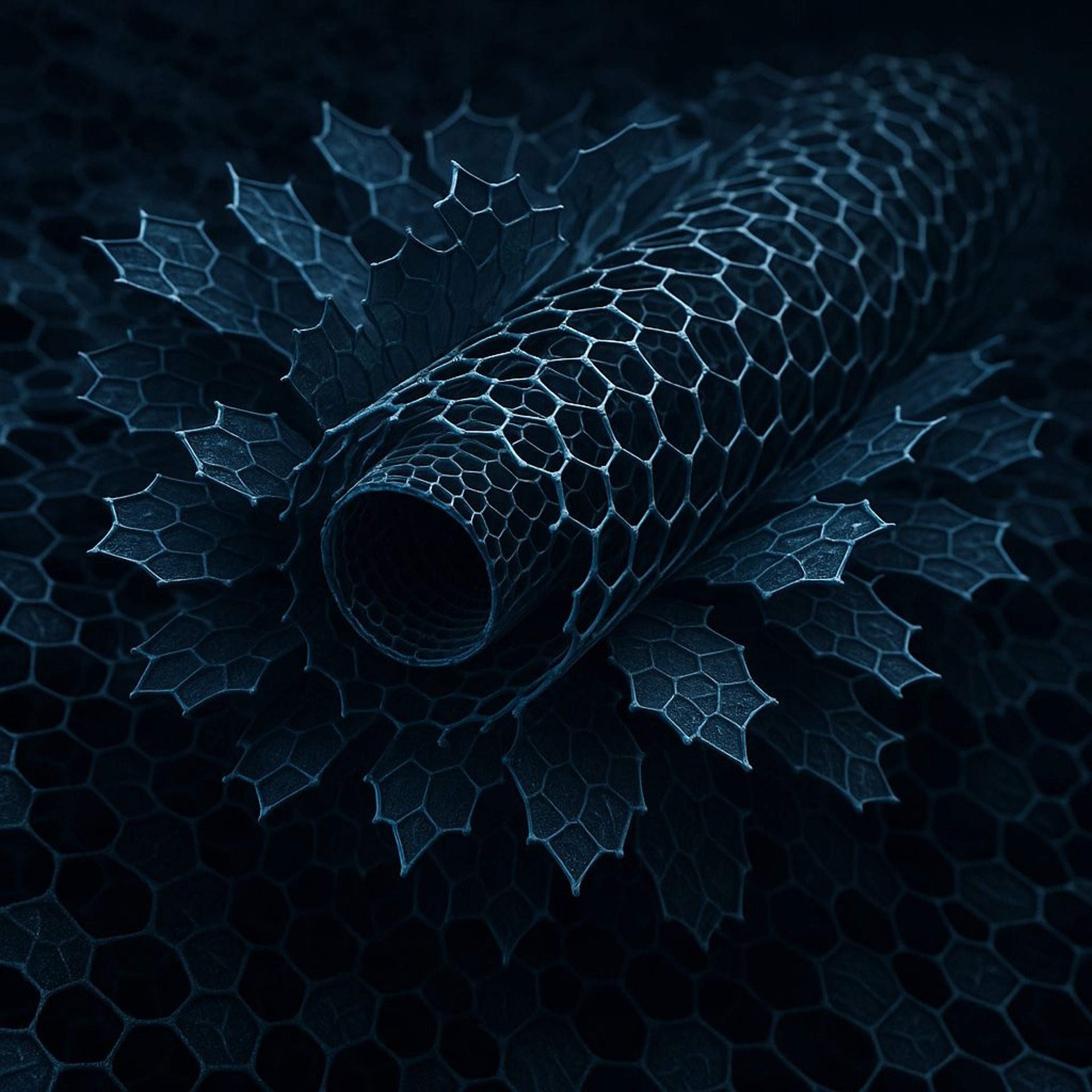
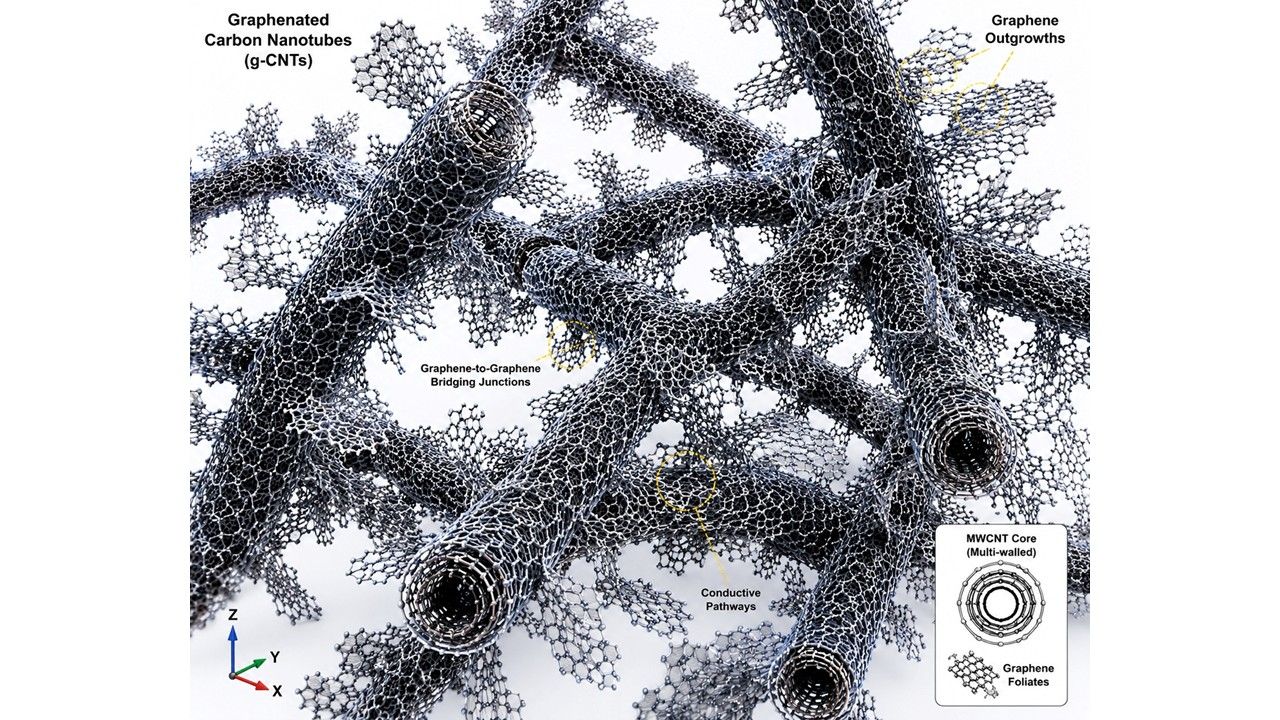
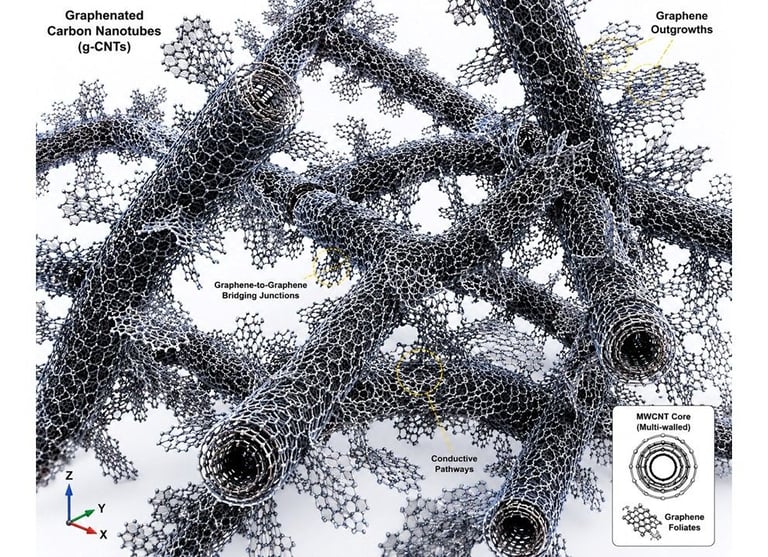
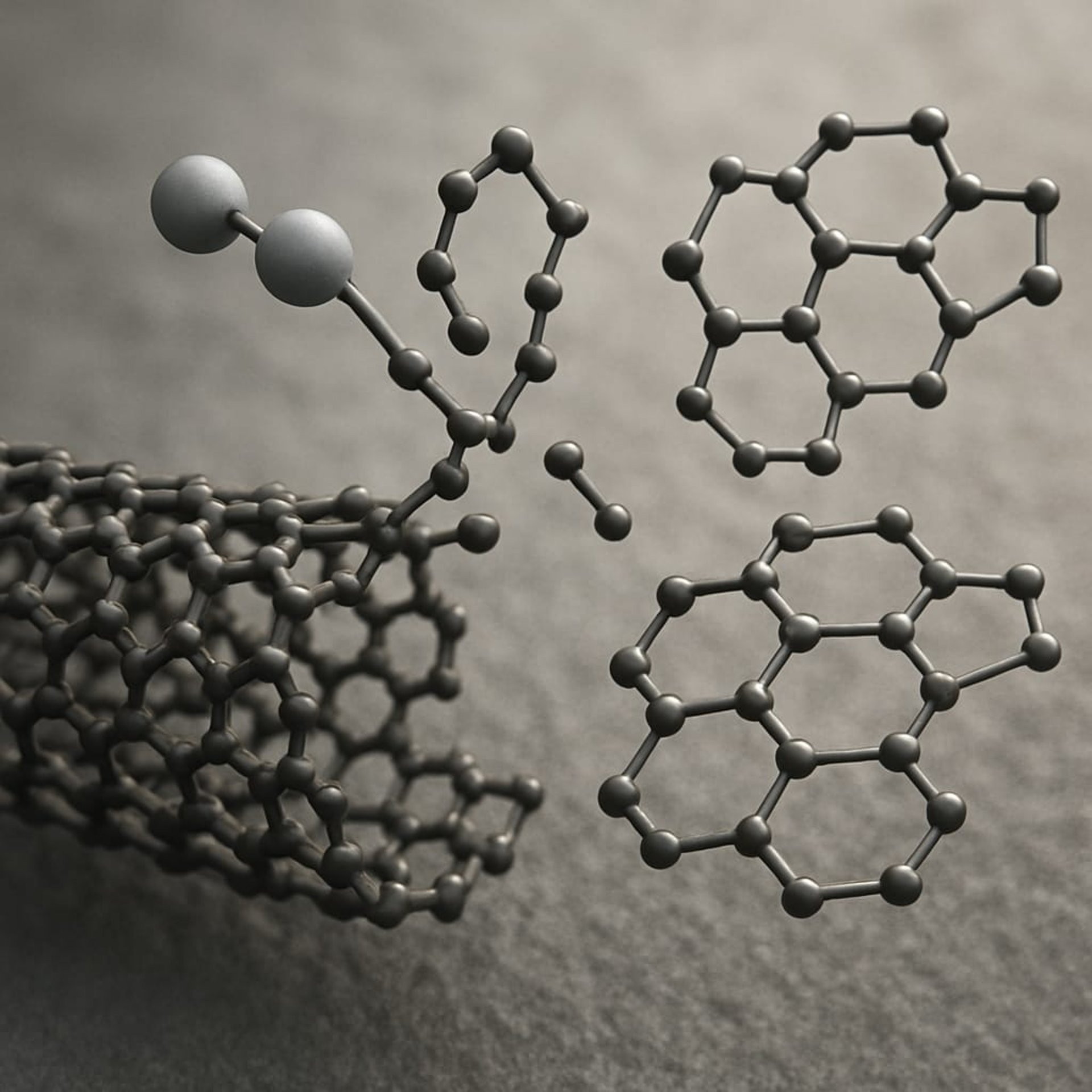
a) The graphene foliates protruding from the MWCNT core physically prevent the 1D backbones from agglomerating. These sp2-hybridized outgrowths act as rigid spacers, preserving an open, mesoporous volume that maintains the high electrochemically active surface area of the individual components.
b) Graphene-to-Graphene Bridging, in standard CNT networks, electrons must tunnel across high-barrier point junctions. Conversely, the gCNT matrix establishes extended planar overlaps between the foliates of adjacent tubes .
c) Instead of tunneling through a restrictive point geometry, electrons exploit large-area π-orbital overlaps. This bridging effectively broadens the contact zone, shifting the inter-particle charge transfer mechanism from high-barrier quantum tunneling to a lower-resistance, continuous percolative pathway.
Ultimately, this creates an isotropic, 3D conductive network that leverages the ballistic longitudinal transport of the 1D core while utilizing the 2D outgrowths to seamlessly bridge macroscopic spatial gaps.